What Would It Cost to Review Every Record?
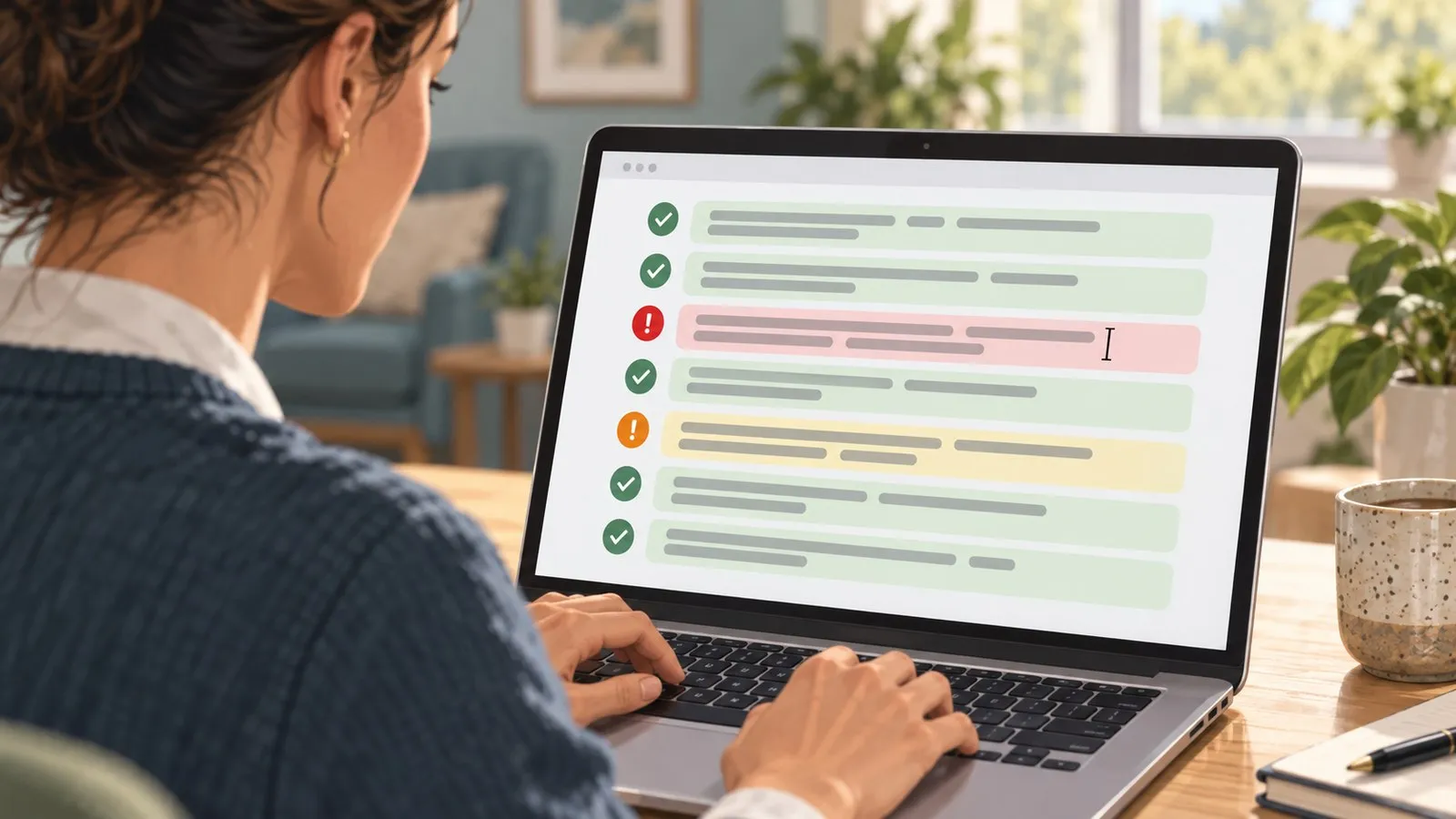
Explore how AI screening, clinician assessment, and focused supervisor review could lower the cost per record and make broader oversight affordable.

Why clinics rely on spot checks
Every record takes time to review, and the people best equipped to review it are often among a clinic's most expensive employees. Clinical supervisors and directors already have staff to support, services to manage, and decisions that require their experience.
Spot checks fit within those demands. Supervisors review a selection of records, often giving newer clinicians more attention. Experienced clinicians can also need corrections, but there is only so much time available to look for them. If a clinic reviews 10 percent of its notes, the other 90 percent remain outside that review.
Reviewing more records means finding more capacity. AI offers a way to change the cost of that first review and direct human attention toward the findings that need it.
What a reviewer needs to see
A useful review looks beyond whether the fields are filled in. It asks whether the note explains the service provided and connects it to the client's treatment.
Consider a session in which a client discusses stress at home. The clinician might use that discussion to practice a skill or address a barrier to a treatment goal. If the note only describes the stressful circumstances, it may leave out the intervention and the reason it belonged in that service.
A reviewer needs to recognize that missing connection. The clinician can then clarify what actually occurred. That is the kind of gap a review process should bring to someone's attention, wherever it appears in the records being checked.
Compare the cost per record
The Bureau of Labor Statistics reports a median wage of about $59.55 an hour for medical and health services managers, a category that includes clinical managers. Using that as a reference point, let's round to $60 an hour for our supervisor.
For a simple example, consider a clinic producing 1,000 notes each month. We'll allow 10–15 minutes for a supervisor to review each note. That puts manual review at $10–$15 per record, or $10,000–$15,000 for all 1,000.
Now consider a workflow in which AI screens the notes against the clinic's selected requirements. Clinicians assess the flags on their own documentation. When a finding is disputed or needs a more experienced interpretation, it goes to the supervisor.
For this example, we'll use these assumptions:
- AI flags 300 of the 1,000 notes, with one finding to assess per flagged note.
- A clinician spends five minutes assessing each finding, at $40 an hour.
- Five percent of those findings—15 in total—are escalated to the supervisor, who spends ten minutes resolving each one.
We're comparing the work of reviewing records and assessing findings.
The clinicians' assessment time comes to 25 hours, costing $1,000. The supervisor spends another two and a half hours on escalations, costing $150. Together, that is $1,150 in human review time across 1,000 screened records, or $1.15 per record.
| Review Approach | Records included | Human review cost per record | Total human review cost |
|---|---|---|---|
| Manual supervisor review | 1,000 manually reviewed | $10–$15 | $10,000–$15,000 |
| AI screening, clinical assessment, supervisor escalation | 1,000 screened; 300 findings assessed; 15 escalated | $1.15 | $1,150 plus software and setup |
Under these assumptions, the human review cost is about 89–92 percent lower. That is the result of this example, rather than a measured saving from a particular product. The comparison shows the economic opportunity: reduce the time spent reading every note from beginning to end, then use professional judgment to assess the findings.
What lower review costs make possible
For clinic leadership, the practical question is how far the review budget can reach. At $10–$15 per record, every additional 100 manual reviews consumes $1,000–$1,500 of supervisory time. A lower cost per screened record creates room to extend coverage across more of the clinic's documentation.
The work also reaches people in a more useful order. Clinicians see questions about their own notes first. Straightforward findings can be addressed close to the original work. Supervisors concentrate on disputed findings, interpretation, and decisions that require their experience. They can use those discussions to identify where a clinician needs further guidance.
Broader screening also creates more opportunities to find documentation gaps before they become payment problems. Its value depends on useful checks against the requirements that apply to the service, and on people acting on the findings. Screening every record describes the reach of the process; the quality of the checks determines what it catches.
Making broader review affordable
In our example, human review costs fall from $10–$15 to $1.15 per record. Across 1,000 records, the difference is $8,850–$13,850 in staff time available to cover those technology costs or support other work.
That is a concrete reason to evaluate AI-assisted review: more documentation can receive an initial check, clinicians can address the findings, and supervisors can focus on questions that need their judgment. The opportunity is to make broader oversight affordable within the realities of running a clinic.
At Everstone Health, that approach guides the tools we are developing: useful feedback for clinicians, focused review for supervisors, and clearer visibility for owners.